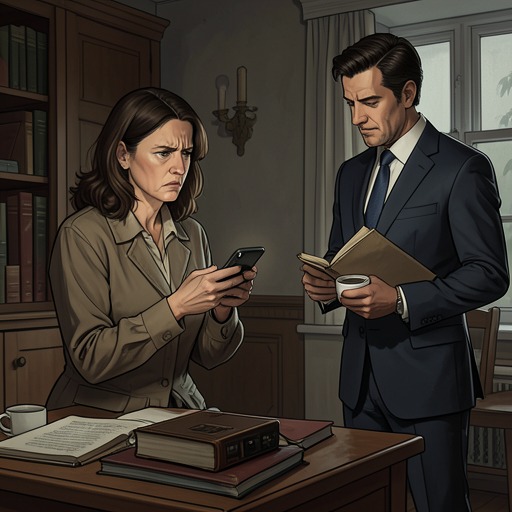
Fran Daly
Day of the DeadFran Daly is an associate medical examiner and a seasoned forensic professional whose disciplined examinations give investigators concrete grounds for action. Once regarded as unlikely to last in a profession where female medical examiners were rare, she has risen to second in command. Her return to Brandon Walker’s working life connects a decades-old reservation case to the present investigation, while her autopsy work shows the urgency with which she treats evidence of prolonged abuse.
Career and Professional Standing
When Brandon visits the Pima County Medical Examiner’s Office, he recognizes Fran as the young woman he knew years earlier, newly out of school and beginning her first job. At that time, female medical examiners were uncommon, and people doubted she would remain in the field. She proved them wrong: she endured, advanced through the ranks, and became the office’s second in command. Brandon’s recollection marks her career as a gradual answer to others’ low expectations, rather than an easy or assumed ascent.
Her professional standing is visible in the contrast between that memory and the authority with which she receives him years later. Brandon expects uncertainty about how the office will respond to an unusual corpse and a request for DNA sampling; instead, Fran comes out to greet him promptly. Their familiarity is personal, but her position also makes her an important point of contact for work that falls outside an ordinary case.
A Return and an Unusual Request
Brandon arrives carrying a coffin in his car. It contains the remains of a fetus from thirty-two years earlier, buried on the reservation in the intervening years. He explains that the investigators are trying to identify the father. Fran’s response changes at once from a friendly reunion to focused professional interest. The request brings forensic work into contact with the long-delayed effort to answer questions surrounding Roseanne Orozco’s death and pregnancy.
The exchange establishes the scope of what Brandon is asking, not the result of any testing: the available evidence does not specify what analysis Fran performs or what conclusion follows. What it does show is that she recognizes the importance of the case and takes the nonroutine request seriously. The coffin’s journey from a reservation grave to the medical examiner’s office makes the investigation’s practical and evidentiary difficulties immediate.
Forensic Judgment
In a separate autopsy, Fran examines an unidentified victim whose fingerprints have already been taken and sent to the laboratory. Her work is thorough and unhurried: she records numerous signs of prolonged physical and sexual abuse, including visible and internal effects, rather than treating the examination as a quick preliminary formality. Her findings support an assessment that the abuse had continued for weeks or possibly months.
Fran communicates the implication plainly to Brian Fellows, stressing both the duration of the abuse and the need to apprehend the perpetrator quickly. The warning is grounded in what her examination can establish; it gives the investigation a measure of urgency without claiming to identify the offender. Across the cases, her role is to convert physical evidence into careful, usable conclusions—and to make clear when those conclusions demand immediate action.
Character and Narrative Role
Fran’s professional manner coexists with a vivid personal presence. When she greets Brandon, she wears a colorful cowboy shirt and expensive snakeskin boots; her gap-toothed smile and powerful handshake make the reunion exuberant rather than ceremonious. She tells him that she still competes in rodeo occasionally, though doing so has become harder over time. These details distinguish her from a merely institutional figure without distracting from her forensic work.
In the investigation, Fran occupies a consequential but bounded role: she examines remains and interprets what the evidence indicates, while detectives and other investigators pursue identification and responsibility. Her career also quietly counters the assumption that she would not last. The same persistence that carried her into senior office underlies the steadiness of her examinations, where patience and blunt clarity serve the search for answers.